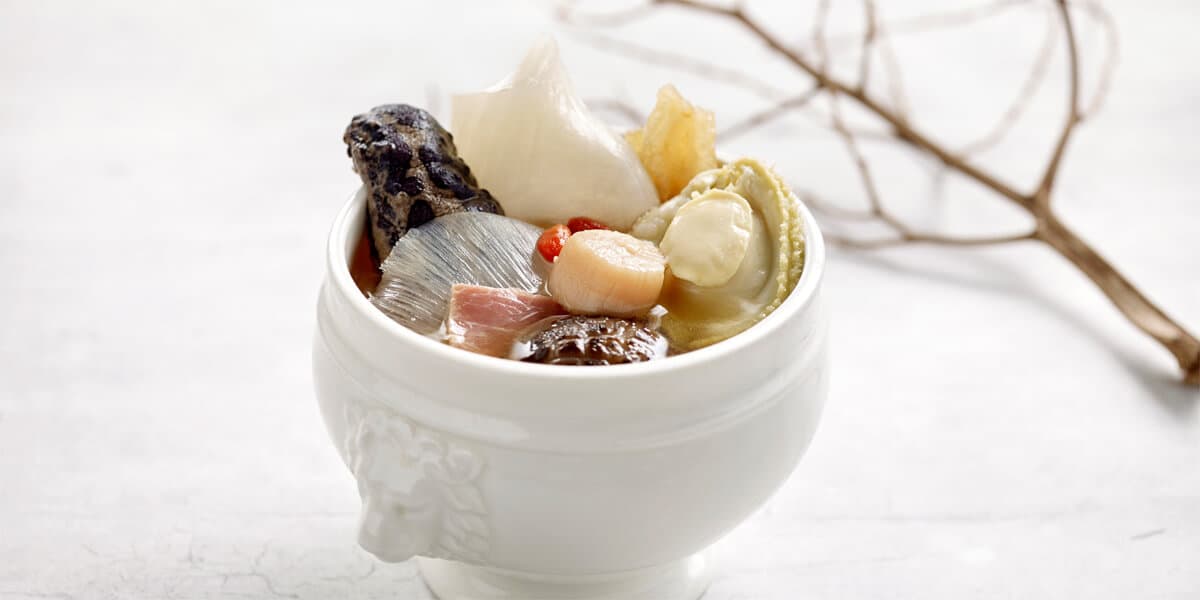
The Legendary Fujian Dish That Made Monks Jump
A scoop of luxury.
Here’s a tip - if you’re planning to order a dish called Buddha Jumps Over The Wall at a Chinese restaurant, be prepared to fork out a lot of money.
Depending on where you are, expect to spend anywhere between $200 to $1,000 on a single order of this rich, complex soup that’s made with as many as 30 different luxury ingredients.
Yet despite its hefty price tag, gourmands seem to have an insatiable appetite for the delicacy, the highlight of lavish banquets and restaurant menus for over a century.
So what does Buddha have to do with this classic dish? And is it really worth the wildly expensive price tag?
What’s in a name?
In Fuzhou, the dish is served in a bowl with Buddha on the lid.
Known as fotiaoqiang in Mandarin, Buddha Jumps Over The Wall can be found in Chinese kitchens across the world, but its roots lie in China’s southeastern Fujian province.
There are a few theories on how this dish earned its peculiar name. One of the most notable involves a group of vagabonds who were sitting outside a Buddhist monastery in Fuzhou, the provincial capital of Fujian.
With little to eat, the beggars decided to chuck all the food they’d gathered for the day - including pieces of meat and some rice wine - into a large earthenware pot.
As this mish-mash of ingredients started cooking, the aroma wafted through the air. The scent of the dish was said to have been so inviting, that the monks on the other side of the wall could barely concentrate on their evening meditation.
Buddha Jumps Over The Wall is a symbol of prosperity.
Tempted by the heavenly smell and desperate to taste the dish, the monks jumped over the wall and joined the beggars, indulging in the hearty meal and breaking their vow to abstain from meat.
Another tale recounts how a monk who was walking past a house caught a whiff of a fragrant dish and was so enticed by the aroma, he jumped over the wall to tuck into the soup.
When he was caught eating the soup with meat in it, the monk simply replied that the dish was so inviting, even Buddha would’ve done the same.
Centuries-old classic
The dish is still cooked in earthenware jars filled with Shaoxing wine.
The most probable origin story, however, has to do with Zhou Lian, a 19th century treasurer of Fujian, who tasted the dish for the first time during a grand dinner.
The dish, called fushoquan or “wishes for luck and longevity” in Mandarin, featured a luscious broth cooked from 20 ingredients including chicken, duck, mutton and seafood that was made by the wife of one of the other officials.
Zhou was so impressed with the divine-tasting soup that he asked a chef by the name of Zheng Chunfa to recreate the dish.
The chef laboured over his recreation, coming up with a version that was said to be even better than the original.
The luxe version of the dish we know now was created more than a century ago.
In 1876, when Zheng put the dish on the menu of his own restaurant, Ju Chun Yuan in Fuzhou, its popularity caught on, and the crowds started coming.
Among its patrons were scholars, one of whom was said to have crafted an impromptu poem in appreciation of the soup: “Pot uncovered, aroma rose tall. Tempted, Buddha jumped over the wall.”
Zheng was so inspired, he renamed the dish Buddha Jumps Over the Wall, which also happens to sound like fushoquan in the Fuzhou dialect.
Cream of the crop
Only premium ingredients are used to create the dish.
Despite tales pointing to its humble beginnings, this dish is now synonymous with wealth and prosperity.
Some of the swankiest Chinese restaurants, both in China and abroad, use at least 15 high quality ingredients, including abalone, sea cucumber, scallops, bird’s nest, pigeon eggs and dry-cured Jinhua ham.
Initially, the dish also included shark fin, a traditional Chinese status symbol. However, many chefs now choose to replace this controversial ingredient with fish maw.
Dried Chinese herbs are essential components of the soup.
It’s not all about prestige, though. Each ingredient is also believed to have medicinal properties that help maintain good health.
Items like abalone and scallops brim with healthy omega-3 fatty acids and imbue the broth with a deep umami flavour, while chewy sea cucumbers are a certified antioxidant superstar.
Likewise, herbs like wolfberries, jujubes, ginseng and codonopsis root, which add herbal notes to the dish, are also chock-full of essential vitamins.
Labour of love
Each ingredient is cooked separately using different techniques.
In Ju Chun Yuan, generations of chefs continue to create this complex dish using the recipe and wisdom handed down to them more than 140 years ago by Zheng Chunfa.
The entire process - from sourcing the finest ingredients to cooking and stewing - can take up to four days and requires exceptional skill.
Chefs must first soak dried foods like abalone for over 20 hours before cooking the ingredients separately to extract the full flavour from each item.
Chefs also have to boil pigeon eggs, steam ingredients like sea cucumber and abalone and stir-fry cuts of meat like chicken feet, duck gizzard and pork tripe.
All the cooked ingredients are then placed in a large jar of Shaoxing wine, covered with a lotus leaf and left to stew over a charcoal fire for over two hours.
To emphasise the lavishness of the dish, chefs usually crown the broth with the most expensive ingredients, such as abalone, sea cucumber, fish maw and scallops.
Tasting prosperity
The dish is a must-have at Chinese weddings and big banquets.
Buddha Jumps Over The Wall may have been crafted more than a century ago, but this iconic, ultra-lux soup is very much in demand today.
In China, the dish is the centrepiece at banquets and is served to visiting dignitaries, with King Norodom Sihanouk of Cambodia and Britain’s Queen Elizabeth II among those who’ve sampled it.
Elsewhere, home cooks are attempting to create their own, less exorbitant versions with canned ingredients, while others look to affordable, ready-to-heat Buddha Jumps Over the Wall soup packs that are a hit all year round.
Whether you’re burning a hole in your pocket at a fancy restaurant or slogging away in the kitchen to put your own spin on the soup, one thing’s for certain - the aroma of this tempting dish is pretty hard to resist.
And perhaps, this is proof that holy men did jump.
Kerry-Ann Augustin
16 August 2022