Car Rental in Hong Kong: Costs, Rules & Booking Tips
Planning car rental in Hong Kong? Compare costs, licence rules, and smart booking tips for driving in HK. Use our complete guide to plan with confidence.
Car rental in Hong Kong gives you direct access to tranquil coastlines, hiking trails, and hidden neighborhood gems beyond the city lights. Whether you're seeking spontaneous day trips or stress-free flexibility for your group, the right preparation will ensure your rental adventure is smooth, cost-effective, and tailored for your needs. This guide breaks down what you truly need to know: actual costs, crucial rules, and smart booking tips so you're ready to hit the road.
Is renting a car in Hong Kong actually worth it?
Weigh the pros and cons of car rental versus public transport for your trip.
Hong Kong is famed for its efficient public transport. However, car hire in Hong Kong has clear advantages for certain situations:
-
Great for:
- Families or groups with lots of luggage.
- Day trips to areas where public transport is limited (Sai Kung, New Territories, Tai Mo Shan).
- Travellers with complex or flexible schedules and multiple stops.
-
Consider alternatives:
- For city-center travel (Central, Tsim Sha Tsui, Causeway Bay), the MTR, taxis, and Airport Express are typically much faster. Additionally, they help you avoid stressful parking or traffic congestion.
Ultimately, the decision comes down to your itinerary. Urban explorers often save time with public transport. In contrast, those venturing further benefit from the freedom a vehicle offers. Still unsure? Continue reading for eligibility, costs, booking tips, and a reality check on driving in Hong Kong.
Who can rent a car in Hong Kong: licence and document requirements
Essential licence, age, and document rules for all rental applicants.

To rent a car in Hong Kong, you'll need to confirm your eligibility and present the right documentation:
- Driving licence: Accepted options include a Hong Kong driving licence or a recognized overseas licence. If your licence isn't in English or widely accepted, secure an International Driving Permit (IDP). Furthermore, policies vary by rental provider—always check in advance.
- Identity proof: Visitors typically show a passport with valid entry; residents use a HKID card.
- Minimum age: Most companies require drivers to be 25 or older. Younger drivers may face additional conditions or be excluded.
- Licence holding period: Generally, 24 months is required, but some companies demand up to 36 months of driving experience, especially for overseas licences.
- Credit card: Payment must be made by the lead driver. As a result, a credit card is needed for the deposit or security pre-authorization; deposit amounts vary by provider.
- Additional drivers: Any added driver needs to present the same documents and may be subject to extra checks or fees.
All legal and recognition rules are detailed by Hong Kong's Transport Department (official link). If document requirements are unclear elsewhere in this guide, refer back to this section for full details.
How much does car rental in Hong Kong cost?
Get a quick, actionable breakdown of real-world costs.
Prices for car rental in Hong Kong vary based on car class, dates, and extras. Here are the main highlights:
Indicative daily base rates:
- Compact/Economy: HK$400–700
- Mid-size/SUV: HK$700–1,500
- Luxury: HK$1,500–4,000
- Supercar: HK$5,000+
- Aggregator averages (all classes): HK$120–186/day
Main cost drivers:
- Insurance tier (basic to super CDW/zero-excess add-ons)
- Young/additional driver surcharges
- Mileage limitations
- One-way or airport pickup fees
- Deposit amount
Ongoing usage costs:
- Fuel (usually full-to-full policy)
- Tunnel and harbour crossing tolls (HK$20–60 per crossing)
- Parking (HK$20–40/hr in central districts)
- Autotoll tag (may incur extra charge)
Always check your final quote for these line items—real costs are often higher than the headline daily rate.
Compact, family, luxury, or supercar: which rental fits your trip?
Use case guide to choosing the right car class for your Hong Kong journey.
| Vehicle class | Best use case | Passenger + luggage capacity | Indicative daily cost range (HKD) | Key decision factors |
|---|---|---|---|---|
| Compact/Economy (e.g. Toyota Yaris) | City driving, short trips, budget-friendly, easy parking | 4–5 passengers, 2–3 bags | See cost section | Good for couples or small groups; less ideal for large bags or remote spots |
| Mid-size SUV/Family (e.g. Honda CR-V or Toyota Sienna) | Airport runs, family travel, carrying more luggage | 5–7 passengers, 3–5 bags | See cost section | Great for groups; check for fold-flat seats and child seat availability |
| Luxury Sedan (e.g. Mercedes E-Class, BMW 5 Series) | Business trips, special occasions, premium comfort | 4–5 passengers, 2–3 bags | See cost section | Prestige; note stricter driver requirements and insurance |
| Supercar (Porsche 911, Lamborghini Huracán) | Unique events, ultra-high-end trips, niche appeal | 2 passengers, 1–2 bags | See cost section | Often highly restricted on use, deposit, and mileage |
Below, we focus only on suitability—cost breakdowns are in the main cost section.
Where to book and collect your rental: city vs airport pickup
Make booking easier—compare the pros and cons of pickup locations.
Airport Pickup:
- Convenient for new arrivals with luggage and tight schedules.
- Not every company has counters at HKIA—some have offsite locations. Therefore, confirm exact arrangements in advance.
- Watch for airport pickup surcharges (typically HK$300–360); these are not always visible in the daily rate.
City Pickup:
- Ideal if you're already in Hong Kong or wish to avoid airport-specific fees.
- Branches are located in areas like Central, Kowloon, and Causeway Bay.
- Suits longer stays and residents, often with greater flexibility on return times.
Booking Tips:
- Aggregator sites show live inventory and pricing across companies—good for price comparison.
- Moreover, booking direct sometimes reveals clearer deposit, insurance, or special terms.
- Choose based on your itinerary, and always check your final price for all location-based surcharges before paying.
Your pre-booking checklist: what to verify before you pay
Run through these high-level checks to avoid costly mistakes.
AI generated image
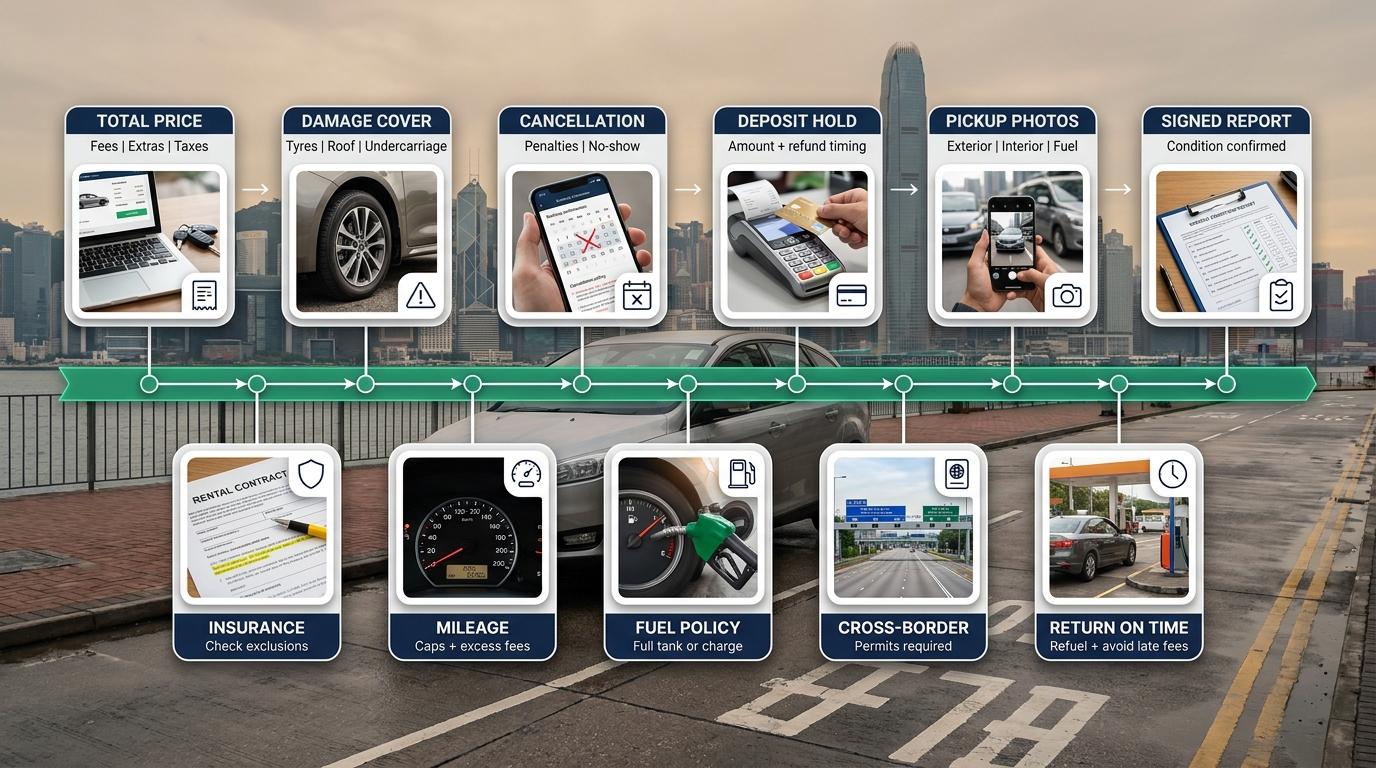
- Compare the total quoted price—including taxes, surcharges, and extras, not just the daily rate.
- Review the insurance package and note exclusions, especially for tyres, windows, undercarriage, or roof (detailed insurance tips in FAQ).
- Confirm mileage limits and any excess charges for overages.
- Additionally, check cancellation, change, and no-show policies.
- Know your fuel policy (full-to-full, prepaid, or other).
- Verify required deposit amount and credit card policy.
- If applicable, confirm cross-border travel restrictions (see the FAQ for details on cross-boundary rules).
On pickup day:
- Take time-stamped photos of the car's exterior/interior to document condition.
- Furthermore, insist all previous damage is logged on paperwork before departure.
On return:
- Refuel as required; return the car on time; and obtain the return inspection report.
For expanded answers on insurance, border crossings, or special circumstances, refer to the dedicated FAQ section below.
Driving in Hong Kong: what visitors need to know
Learn unique rules, safety requirements, and smart driving tips for Hong Kong.
- Drive on the left side of the road; most signs are in both English and Chinese.
- Core urban areas face slow traffic and tight, costly parking—paid multi-storey lots are the norm. Consequently, illegal parking is heavily penalized.
- All car occupants must wear seatbelts; drink-driving rules are strictly enforced (limit: 22 micrograms/100ml breath).
- Avoid bus lanes during restricted hours—they're closely monitored.
- Tunnels and expressways may require either an Autotoll tag (electronic payment) or have manual cash lanes. As a result, always check what's included with your rental.
Local tip: For scenic escapes—Sai Kung Peninsula, Clearwater Bay, and the New Territories—car hire in Hong Kong provides unmatched flexibility. For everyday urban outings, however, public transport remains faster and less stressful.
Always refer to Who can rent a car in Hong Kong: licence and document requirements for up-to-date eligibility and documentation guidance.
Common questions about renting a car in Hong Kong
Find answers to unique and practical car rental scenarios.
Final verdict: should you rent a car in Hong Kong?
Key decision points to help choose if car rental fits your Hong Kong journey.
Car rental in Hong Kong is best for travelers whose plans require frequent regional trips, extra space for family or luggage, and flexibility far from MTR lines. For urban-focused visitors, however, the city's public transport network is almost always faster and simpler. Before you book, check you're eligible, compare real prices and insurance, and choose a pickup that matches your itinerary. Ask yourself:
- Will my trip mostly be urban, or do I want to reach the New Territories and beaches?
- Am I comfortable navigating unfamiliar, congested city traffic and finding parking?
- Is my group size or luggage better served with private transport?
Making the right call means matching transit comfort, cost-efficiency, and flexibility to the style of Hong Kong adventure you want. Therefore, research your options, book ahead if possible, and you'll maximize both value and enjoyment during your stay. Ready to get started? Book your flight to Hongkong and book with confidence.

Chayanit P.
7 Sep 2026