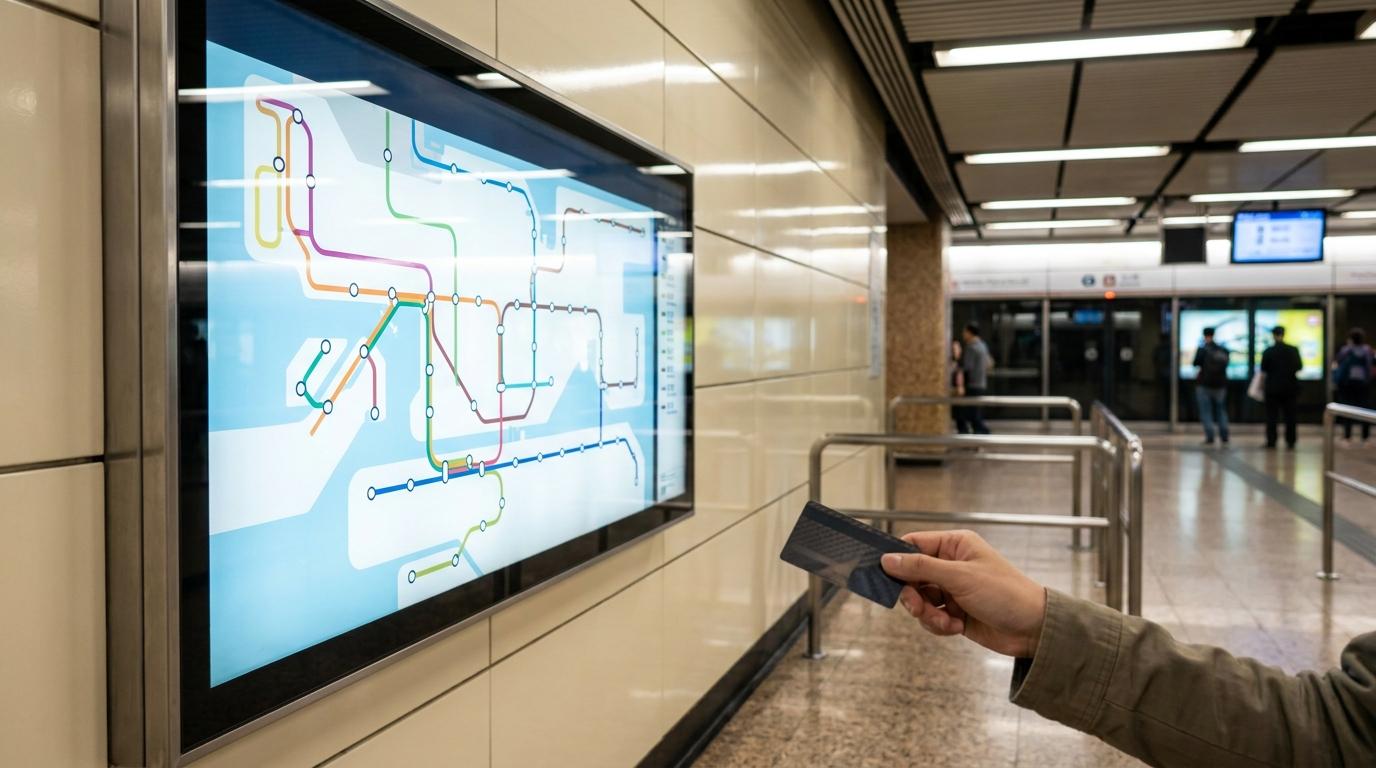
Hong Kong Train Map: How to Navigate the MTR
Hong Kong train map to the MTR lines,plan city journeys, and travel with confidence across Hong Kong.
Arriving in Hong Kong, you'll notice that the city pulses around an extensive, color-coded MTR system that connects all major neighborhoods, shopping hubs, and attractions. Though the map can appear overwhelming at first glance, this guide is designed to give you the confidence and quick orientation needed to make sense of it and navigate the city with ease.
Your fastest way to read the Hong Kong rail network
The Hong Kong train map is your go-to tool for moving around the city. Its structure may seem intricate, but it's made for convenience: all central neighborhoods are interlinked, and you can reach even outlying destinations like Hong Kong International Airport or the border with mainland China via direct lines. The Hong Kong MTR map's intuitive color code—where each line stands out with its distinct shade—allows even new arrivals to orient quickly. To take the guesswork out of planning, use digital trip planners or download the official Hong Kong MTR map PDF for a current, easy-reference guide. For a snapshot of the network and a touch of local trivia: the MTR opened in 1979 with just one line and has since become a celebrated symbol of Hong Kong's efficiency and urban spirit. Furthermore, understanding the MTR map early helps you save both time and money throughout your stay.
The Hong Kong train map at a glance
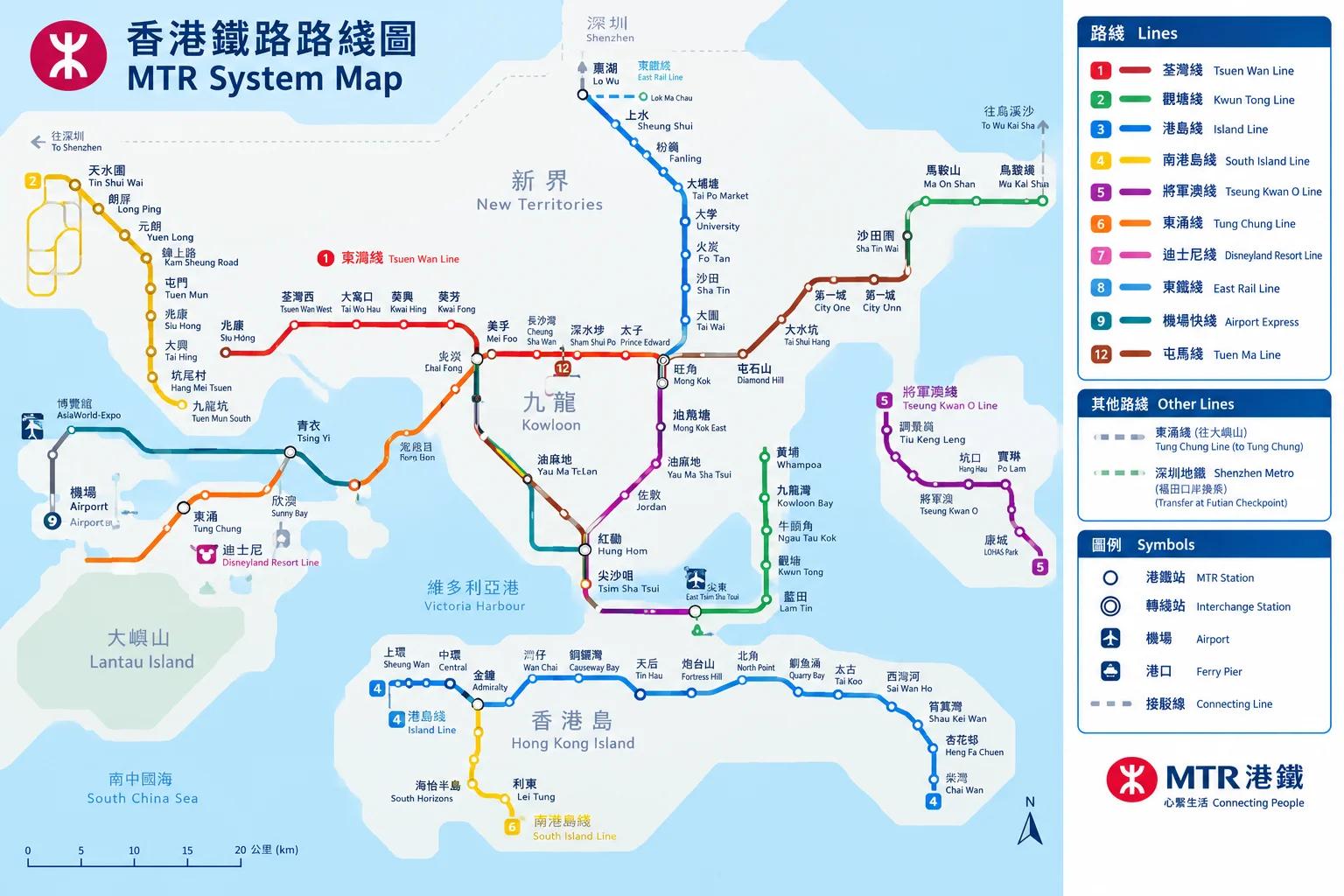
- The MTR map is instantly recognizable for its vivid palette of lines, each color marking a route and helping guide millions of daily passengers with clarity—much like the iconic Tube map in London.
- Over four decades, the MTR network has connected city, suburbs, and airport, making the city's vibrant heart and scenic fringes easily accessible.
- For visitors, some facts to note: the map's earliest lines transformed entire districts, consequently opening up nightlife, culture, and commerce across Hong Kong in the process. Today, it's both a navigation tool and a symbol of local ingenuity.
- Access the latest route map for free at every station or online as a PDF, and enjoy exploring with one of the world's most punctual rail systems.
How to read line colors, stations, and interchanges
Understanding MTR Line Colors
- Each MTR line is represented by a bright color:
- Red: Tsuen Wan Line
- Dark blue: Island Line
- Green: Kwun Tong Line
- Always use color as your main reference—it's faster than remembering every line name. Moreover, the Hong Kong train map relies entirely on this color system to keep navigation intuitive for all travelers.
Navigating Stations and Transfers
- Interchange stations are marked with circles or transfer symbols—these allow you to switch easily between lines at major hubs like Admiralty, Central, Mong Kok, Prince Edward, and Lai King.
- Not every line crossing indicates a real interchange—look for the transfer symbols on the map.
Train Directions
- Trains run toward each line's terminus, and platform signs display the name of the last station (not compass directions). For example, Island Line trains will show "to Chai Wan" or "to Kennedy Town."
Special Map Symbols
- The Airport Express stands out as a dedicated teal line.
- Light Rail serves the north-west New Territories with its own branch on the diagram.
- Cross-border rail lines (like the East Rail Line to Lo Wu and Lok Ma Chau) are highlighted with special markers.
For the current official line map, including color codes, interchanges, and system icons, refer to the Hong Kong MTR map PDF.
MTR lines and interchanges worth knowing
| Line | Line color | Key stations for tourists | Main interchange | Best use case for travelers |
|---|---|---|---|---|
| Tsuen Wan Line | Red | Tsim Sha Tsui, Jordan, Yau Ma Tei, Mong Kok | Prince Edward | For shopping at Mong Kok's street markets, night views at Tsim Sha Tsui promenade, and Kowloon's lively bazaars. |
| Island Line | Blue | Sheung Wan, Central, Admiralty, Wan Chai, Causeway Bay, Quarry Bay | Admiralty | Perfect for exploring art in Central, the nightlife in Wan Chai, and shopping in Causeway Bay. |
| Kwun Tong Line | Green | Wong Tai Sin, Diamond Hill, Choi Hung, Kowloon Bay, Kwun Tong | Mong Kok | Get to Wong Tai Sin Temple, Chi Lin Nunnery, and family-friendly Kowloon Bay parks. |
| Tung Chung Line | Orange | Hong Kong, Kowloon, Tsing Yi, Sunny Bay, Tung Chung | Sunny Bay | Direct for Lantau Island, access to Ngong Ping 360 cable car and the Big Buddha, and Disney via Sunny Bay. |
| Airport Express | Teal | Hong Kong, Kowloon, Tsing Yi, Airport, AsiaWorld-Expo | Hong Kong Station | Ideal for ultra-fast trips from the airport to Central and Kowloon, plus in-town airline check-in at stations. |
| East Rail Line (cross-border) | Light blue | Admiralty, Hung Hom, Sha Tin, Tai Wai, Lo Wu, Lok Ma Chau | Admiralty | Access border crossings for Shenzhen and catch New Territories countryside scenery along the way. |
Getting to the city on the Airport Express
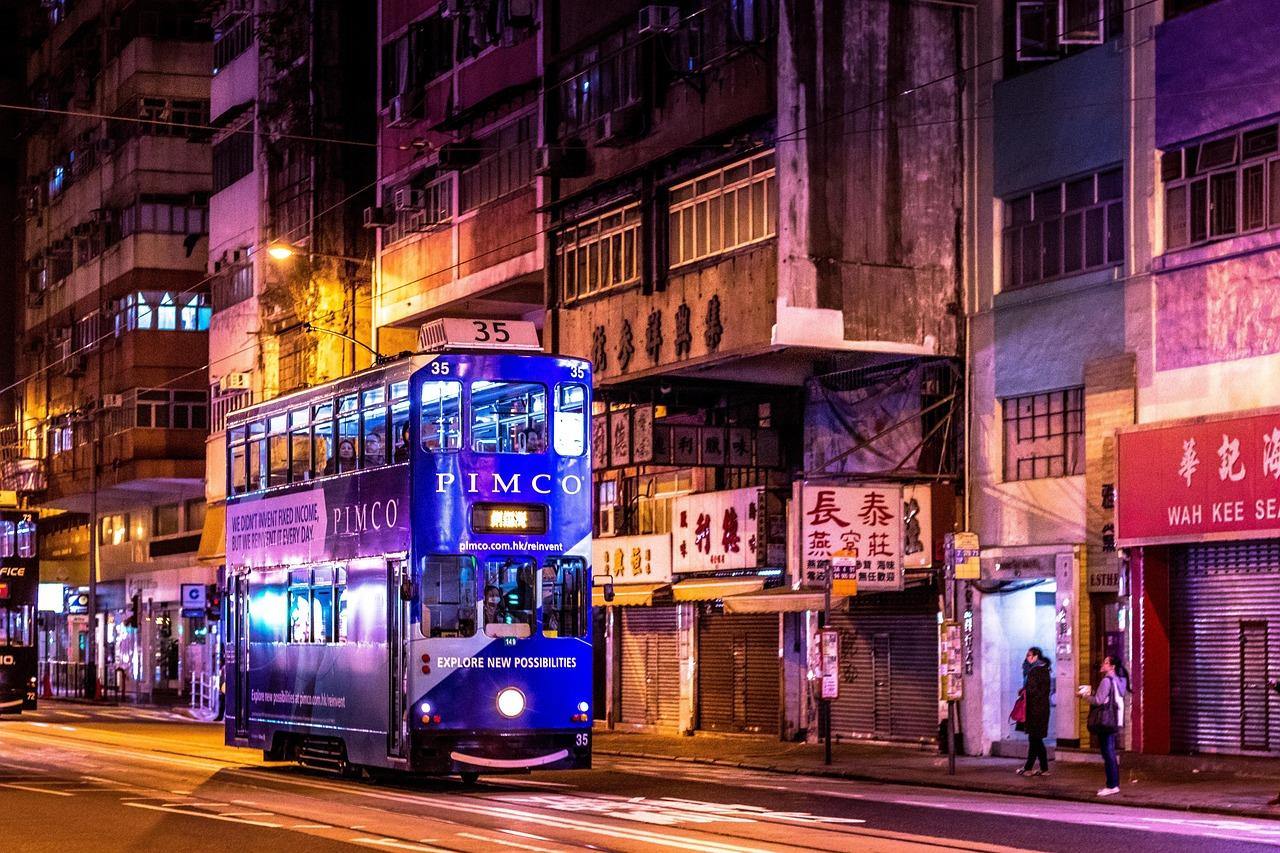
Hong Kong night cityscape with bus, by nextvoyage
Travelers rave about the Airport Express as the smoothest connection from Hong Kong International Airport to downtown. One recent visitor shared,
Which Hong Kong Train Line Should I Take to Each Attraction?
Use this table to identify the nearest practical station and recommended train line for popular attractions around Hong Kong.
| Attraction | Recommended Station | Train System | Walking / Onward Connection |
|---|---|---|---|
| Victoria Peak | Hong Kong or Central | MTR Island Line | Walk to the Peak Tram Lower Terminus or take a taxi to the tram station |
| Victoria Harbour (Tsim Sha Tsui waterfront) | Tsim Sha Tsui or East Tsim Sha Tsui | Tsuen Wan Line or Tuen Ma Line | Walk to the waterfront and Avenue of Stars |
| Hong Kong Disneyland | Disneyland Resort | MTR Disneyland Resort Line | The station is a short walk from the park entrance |
| Ocean Park | Ocean Park | MTR South Island Line | Walk to the park entrance from the station |
| Ngong Ping 360 and Tian Tan Buddha | Tung Chung | MTR Tung Chung Line | Walk to the Ngong Ping 360 cable car terminal, then take the cable car |
| Ladies' Market, Mong Kok | Mong Kok | Tsuen Wan Line or Kwun Tong Line | Walk to Tung Choi Street and the surrounding shopping streets |
| Temple Street Night Market | Jordan or Yau Ma Tei | MTR Tsuen Wan Line | Walk to Temple Street |
| Wong Tai Sin Temple | Wong Tai Sin | MTR Kwun Tong Line | The temple is close to the station |
| Hong Kong Museum of History | Tsim Sha Tsui or East Tsim Sha Tsui | Tsuen Wan Line or Tuen Ma Line | Walk to the museum; check current opening status before visiting |
| Central and SoHo | Central or Sheung Wan | MTR Island Line | Walk to the Mid-Levels Escalator, SoHo and nearby dining streets |
| Causeway Bay shopping district | Causeway Bay | MTR Island Line | Walk to Times Square, SOGO and nearby shopping streets |
| Hong Kong Convention and Exhibition Centre | Exhibition Centre | MTR East Rail Line | Walk to the venue from the station |
Travel tip: Check the official MTR system map before travelling, as the most convenient route depends on your starting point and any interchange needed.
Hong Kong Train Fares and Payment Options
Hong Kong train fares vary by operator, travel distance and ticket type. The MTR offers several payment options, including Octopus cards, contactless bank cards on supported services and single-journey tickets. Check the official MTR website for the latest fares and payment arrangements.
| Train System | Typical Fare Guidance | Payment Options |
|---|---|---|
| MTR | Depends on distance, route and ticket type | Octopus card, single-journey tickets and supported contactless payment methods |
| Airport Express | Depends on destination and ticket type | Octopus card, tickets purchased through official channels and supported payment options |
| Light Rail | Depends on journey and ticket type | Octopus card and accepted ticketing options |
| High-speed rail (Hong Kong West Kowloon) | Depends on destination, train and ticket class | Advance booking through official ticketing channels and accepted payment methods |
| Tram (Ding Ding) | Flat fare for adult passengers; check current rates | Octopus card, accepted contactless payment methods and cash where supported |
| Star Ferry | Depends on route, passenger type and deck | Octopus card, tickets and other accepted payment methods |
For current fares, routes and payment details, visit the official MTR website or the High Speed Rail website.
Planning a journey step by step
Follow these clear steps for hassle-free navigation on the Hong Kong train map:
- Locate your destination: Find your stop on the MTR map by its official name, not just the nearest landmark or address. This ensures you pick the right route and avoid confusion during platform changes.
- Trace your line and direction: Use the map's distinct line colors to see your route—match the platform signs inside the station for your destination direction (look for the line's final station name).
- Plan any required transfers: Identify all needed interchanges; switch at those stations marked as transfer points. For Airport Express connections or special routes, mind separate ticket gates/platforms.
- Confirm with digital tools: Use the MTR Mobile app or website to verify your route, see live alerts, buy e-tickets or find special station amenities.
Sample journey: Arriving from the airport and heading to Causeway Bay's shopping? Board the Airport Express to Hong Kong Station, then transfer to the blue Island Line (direction Chai Wan), and hop off at Causeway Bay. Let MTR Mobile confirm the route and ticket type.
Tickets & payments: The Octopus card is the hands-down favorite for ease and value. QR code tickets from MTR Mobile are fine for single trips, but double-check which gates accept your ticket type. New to Octopus? Read our Octopus card guide for details on purchasing and topping up.
Plan Your Hong Kong Adventure
Getting around Hong Kong is easier when you understand the train map and know which MTR line connects to your destination. Plan your itinerary around the attractions you want to visit, and explore our guides on weekend getaways in Hong Kong for trip inspiration, how much to bring to Hong Kong to plan your travel budget, and the Hong Kong airport guide to plan your arrival and onward transport. Ready to explore Hong Kong? Book your flight to Hong Kong with AirAsia and start planning your next adventure!
Cross-border and high-speed rail from Hong Kong
If your travels extend beyond Hong Kong, the city's rail system smoothly connects to the Chinese mainland. The East Rail Line takes you straight to border checkpoints at Lo Wu and Lok Ma Chau—ideal for a quick visit to the urban buzz of Shenzhen. These lines operate frequently and, as a result, make the cross-border process efficient, with straightforward immigration at each end. For destinations like Guangzhou, board high-speed trains at West Kowloon Station, where both Hong Kong and mainland immigration are completed before you board. This service offers reserved seating and impressive journey times—roughly 14 minutes to Futian, under an hour to Guangzhou South. Be sure to check the latest travel document requirements and leave enough time for check-in and security at the station. Even if you don't plan a cross-border trip, knowing these options is handy for future adventures or escapes to neighboring cities.
FAQs

Chayanit P.
1 Oct 2026