
Connecting Flight Itinerary Examples: How to Plan Your Route
Planning a connecting flight itinerary can give you more options when travelling to a destination without a convenient direct flight. The key is to choose a suitable transit airport, allow enough time between flights and understand how your tickets, baggage and entry requirements affect the journey.
For example, a trip from Jakarta to Tokyo could connect through Kuala Lumpur, while a journey from Kuala Lumpur to Paris might involve another international hub. Each route comes with different transfer requirements, travel times and potential risks.
This guide covers four connecting flight itinerary examples, explains how to plan your route and shows you what to check before booking.
What Is a Connecting Flight Itinerary?
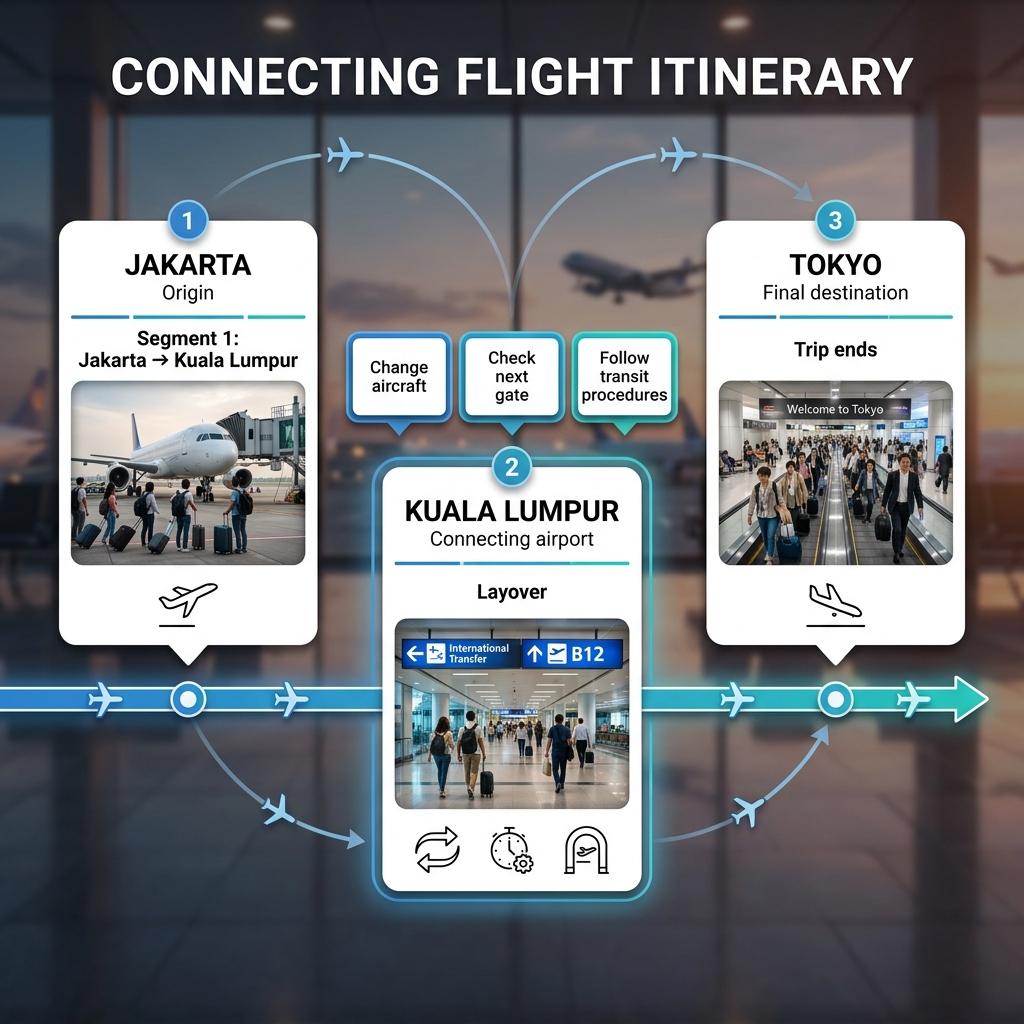
A connecting flight itinerary is a journey that uses two or more flight segments to reach your final destination, with a transfer at an intermediate airport.
For example, a journey from Jakarta to Tokyo via Kuala Lumpur has three main points:
- Origin: Jakarta, Indonesia
- Transit airport: Kuala Lumpur, Malaysia
- Final destination: Tokyo, Japan
After landing in Kuala Lumpur, you transfer to your next flight to Tokyo. Depending on your booking and airport procedures, you might stay in the international transit area or need to pass through immigration, collect your baggage and check in again.
A connecting flight can be booked as one protected itinerary or as separate tickets. This distinction matters because it affects what happens if your first flight is delayed.
Four Connecting Flight Itinerary Examples
These examples show how different connecting flight routes work. They are illustrative routes, not confirmed flight schedules. Check current availability, total journey time and transfer conditions for your travel dates.
1. Jakarta to Tokyo via Kuala Lumpur
Example route: Jakarta (CGK) → Kuala Lumpur (KUL) → Tokyo (NRT or HND)
This is an example of an international journey with one connection. Instead of flying directly to Tokyo, you travel through Kuala Lumpur before continuing to Japan.
What to consider:
- Compare the total journey time, including the layover, rather than looking only at the fare.
- Confirm the arrival and departure airports and terminals.
- Check whether both flights are on one protected booking or on separate tickets.
- Ask whether your checked baggage will be transferred to Tokyo.
- Check the entry or transit requirements for your nationality and itinerary.
A two-hour layover may be sufficient for some protected connections, but it is not a universal recommendation. If you must collect your baggage, clear immigration or check in for a separately booked flight, you may need considerably more time.
Best for: Travellers who want a straightforward route with one intermediate stop.
2. Kuala Lumpur to Paris via a Transit Hub
Example route: Kuala Lumpur (KUL) → Doha (DOH) → Paris (CDG)
This example shows how a connecting flight can link Southeast Asia with Europe. The journey has two flight segments and one transit airport.
Long-haul connections can involve additional document checks, different terminal arrangements and lengthy walks between gates. However, the time required depends on the airport and specific flights, not simply on the fact that the journey is international.
What to consider:
- Check the minimum connection time for the specific itinerary.
- Confirm whether the flights are sold as one protected journey.
- Check baggage arrangements and any additional security or document checks.
- Consider the consequences of a delay, especially if you are travelling on separate tickets.
If you are comparing several routes to Paris, look at the overall travel time, layover duration and ticket conditions together. The cheapest fare may not be the most suitable option if it involves a complicated self-transfer.
Best for: Travellers comparing different routes between Southeast Asia and Europe.
3. Jakarta to Paris with Two Connections
Example route: Jakarta (CGK) → Kuala Lumpur (KUL) → Doha (DOH) → Paris (CDG)
This itinerary has three flight segments and two connections. It illustrates how a journey may involve multiple transit airports when no suitable single-connection option is chosen.
Each additional connection introduces another transfer to plan. A delay on an earlier flight can also affect the rest of the journey, particularly when the flights are booked separately.
What to consider:
- Check the arrival and departure times at both transit airports.
- Confirm that each connection has enough time for the required transfer process.
- Check whether all flight segments are covered by the same booking or protected itinerary.
- Understand where you will collect your checked baggage.
- Review transit visa requirements for both countries, if applicable.
A route with two connections may have a lower fare or more convenient departure time, but compare the total journey duration before making a decision.
Best for: Travellers who want to compare alternative fares, schedules or routes with more than one connection.
4. A Multi-City Trip Through Asia
Example route: Kuala Lumpur → Bangkok → Seoul → Tokyo → Kuala Lumpur
Unlike a conventional connecting journey, this itinerary is designed to include several destinations. You might spend a few days in Bangkok, continue to Seoul and then finish your trip in Tokyo before returning to Kuala Lumpur.
You can arrange a multi-city journey using a suitable multi-city booking or separate flight reservations. The booking structure determines how the flights are ticketed and what happens if a disruption affects a later segment.
What to consider:
- Decide how many nights you want to spend in each destination.
- Check entry requirements for every country you plan to visit.
- Allow enough time between flights if you are booking separate tickets.
- Check baggage allowances and airport transfer arrangements for each segment.
- Compare the cost of a multi-city itinerary with separate one-way flights.
If you plan to explore each city rather than simply change planes, treat each destination as part of your holiday. You will need to account for accommodation, local transport and the time required to enter and leave each country.
Best for: Travellers who want to visit several cities in one trip rather than make a quick airport connection.
How to Plan a Connecting Flight in 8 Steps
A well-planned connecting flight itinerary starts with the destination and ends with a clear understanding of every transfer.
1. Choose your departure and arrival cities
Decide where your trip starts and ends. If direct flights are unavailable or unsuitable, look for routes through transit airports that connect the two cities.
For example, when planning a trip from Jakarta to Tokyo, compare the available routes through Kuala Lumpur and other suitable hubs.
8. Compare the full cost before booking
Compare fares alongside baggage charges, airport transfers, accommodation if needed and other relevant costs.
Choose the route that suits your schedule, budget and comfort level. A slightly higher fare may be worthwhile if it provides a simpler transfer and better protection against missed connections.
7. Understand your ticket conditions
Check whether the journey is booked as one protected itinerary or as separate reservations.
A protected connection generally provides more assistance if a delay causes you to miss your onward flight, subject to the applicable conditions. With separate tickets, you may need to pay for a replacement flight if you miss the next departure.
6. Check visa and entry requirements
Transit requirements depend on your nationality, destination, transit country and whether you need to enter that country during the connection.
Check official immigration or embassy information before booking. Do not assume that you can leave the airport or collect your baggage without meeting the relevant entry requirements.
5. Confirm your baggage arrangements
Check whether your checked baggage will be transferred to your final destination or whether you must collect it during the connection.
If you are travelling on separate tickets, you may need to collect your bags, clear customs and check in again. Confirm the arrangements with the airlines before booking.
4. Check the connection requirements
Look for the minimum connection time applicable to your itinerary. The required time can vary according to the airport, airlines, terminals and type of transfer.
Allow additional time if you need to collect baggage, clear immigration, change terminals or check in for another ticket. Do not assume that a connection is suitable simply because the scheduled layover appears long enough.
3. Calculate the total travel time
Add the duration of every flight and the time spent waiting between flights.
A lower fare may come with a much longer journey. Compare the total time from departure to arrival, not just the time spent in the air.
2. Compare potential transit airports
Look at the connecting airports offered on your travel dates. Consider the airport layout, available onward flights and whether you need to change terminals or airports.
Remember that two airports serving the same city can be far apart. A transfer from Bangkok's Suvarnabhumi Airport (BKK) to Don Mueang Airport (DMK), for instance, is different from moving between terminals within one airport.
How Much Layover Time Do You Need?
There is no single layover duration that works for every connecting flight. The appropriate time depends on the airport, ticket structure, baggage arrangements and procedures you must complete before boarding the next flight.
| Connection type | What to consider |
|---|---|
| Protected connection, same terminal | Check the itinerary's minimum connection time, gate distance and any additional checks. |
| Connection involving a terminal change | Allow time for the transfer method, security checks and possible immigration procedures. |
| Separate tickets with baggage to collect | Allow time for baggage collection, entry formalities, check-in and baggage drop deadlines. |
| Transfer between different airports | Include ground transport time, traffic and the possibility of delays. |
| Long layover | Check airport facilities and whether you can legally enter the transit country if you want to leave the airport. |
For an official reference, the International Air Transport Association (IATA) publishes minimum connection time information for airports and flight combinations. Your actual booking and airline instructions remain important.
If you are travelling with children, have reduced mobility or are unfamiliar with the airport, consider allowing more time than the minimum required.
Same Ticket vs Separate Tickets
One of the most important decisions when planning a connecting flight is how the flight segments are booked.
| Factor | One protected itinerary | Separate tickets |
|---|---|---|
| Booking | Flight segments are sold together as a protected connection. | Each flight has its own booking. |
| Missed connection | Assistance or rebooking may be available under the ticket conditions. | You may need to purchase a replacement ticket. |
| Baggage | Often transferred to the final destination, but always confirm. | You may need to collect and re-check baggage. |
| Check-in | May allow check-in for multiple segments at once. | You may need to check in separately for each flight. |
| Immigration | Requirements depend on the airport and itinerary. | Entry may be necessary if you need to collect bags or check in landside. |
| Planning | Usually simpler to manage. | Requires more independent planning and a larger time buffer. |
Example: If you book Jakarta to Tokyo via Kuala Lumpur as a protected itinerary, the airline arrangements may cover the connection if a delay causes you to miss the onward flight. If you book Jakarta to Kuala Lumpur and Kuala Lumpur to Tokyo separately, you may be responsible for the second ticket if the first flight arrives too late.
Always read the applicable booking conditions rather than relying on the number of airlines involved. Different airlines can operate segments within a protected itinerary.
Plan Your Next Connecting Flight
The best connecting flight itinerary is one that fits your budget, schedule and travel needs while allowing enough time to complete each transfer.
Before booking, compare the available routes, total journey times, baggage arrangements and ticket conditions. Check transit requirements and make sure you understand what happens if a delay affects your onward flight.
Use AirAsia MOVE to explore flight options and compare routes for your next trip. Check the details of your selected itinerary before confirming your booking, particularly if your journey involves separate tickets or a self-transfer.
Connecting Flight Checklist
Before confirming your itinerary, check each item below.
- Confirm the departure airport, transit airport and final destination.
- Check the total journey time and every scheduled connection.
- Confirm whether the flights are on one protected booking or separate tickets.
- Check arrival and departure terminals, including any airport changes.
- Confirm whether checked baggage is transferred or must be collected.
- Check check-in and baggage-drop deadlines.
- Verify visa, immigration and transit requirements using official sources.
- Understand what happens if a delay causes you to miss the next flight.
- Compare the full cost, including baggage and ground transfers.
- Save your booking details and check flight information before departure.
Frequently Asked Questions

Indira L
13 October 2026