Don Mueang Airport Layover & Connecting Flights Guide: What to Know
Plan your Don Mueang Airport layover in Bangkok with practical tips on connecting flights, transit scenarios, immigration, and airport essentials.
Welcome to Don Mueang Airport—a distinctly energetic, budget-focused hub where efficiency beats glitz. If your connection involves DMK, you're stepping into a terminal pulsing with low-cost airlines, direct routes to Asia's corners, and colorful crowds at all hours. This is your no-nonsense, scenario-driven guide to tackling layover anxiety, mastering the DMK
Why DMK layovers aren't as scary as they sound
A Don Mueang Airport layover is often met with apprehension—compact terminals, vivid crowds, and a reputation for confusion. Most anxiety comes from not knowing what to expect. Once you understand the simple logic of DMK's transit flow, you'll find it's a well-oiled machine for smart planners. Immigration lines and baggage rules are covered step-by-step in the sections below. With the right prep, the chaos is manageable. It's about knowledge, preparation, and using specific strategies to turn a dreaded Bangkok stopover into a routine travel milestone. Whether you're a first-timer or a frequent flyer through Don Mueang, understanding the terminal layout, transfer types, and visa requirements transforms your DMK connection experience entirely.
How connecting flights actually work at Don Mueang Airport layover
The Don Mueang Airport layover experience comes down to two elements: your ticket type and your flight route. Single through-ticket passengers enjoy a seamless airside transfer—no passport queues, no baggage stops. Separate tickets mean extra steps: clear immigration, collect bags, and re-check before boarding. DMK's layout is functional and straightforward. Whether you breeze through or start from scratch depends on those two variables. Understanding these pathways is essential for every traveler planning a DMK transit or stopover connection. Read the breakdowns below for each pathway.
Domestic to Domestic Connections
A same-ticket domestic transfer means walking from your arrival gate in Terminal 2 to your next departure—no immigration, no baggage claim. It's the fastest connection type at Don Mueang. On separate tickets, you must claim your luggage, exit through arrivals, and check in upstairs—adding complexity and time to your DMK transit.
International to Domestic Connections
All routes from abroad begin at immigration in Terminal 1. With a same-ticket Fly-Thru service, use the dedicated transfer desk and your bags go straight to your final domestic stop. If flights are booked separately, you must clear immigration, collect bags, and walk to Terminal 2 to re-check yourself and your luggage during your Don Mueang Airport layover.
Domestic to International Connections
Arriving at Terminal 2 and departing from Terminal 1 is common for international journeys. On separate-ticket bookings, retrieve your bags at arrivals, make the five to ten-minute walk to Terminal 1, then check in and clear outbound immigration. Factor in queues for check-in and passport control—not just the physical walk—when planning your DMK connection buffer time.
International to International Connections
With a true through-ticket or Fly-Thru service, transfer between international flights by following transit signs—no immigration, no baggage claim. If you self-connect with separate bookings during your Don Mueang Airport layover, clear Thai immigration, collect bags, and check in again before proceeding through security for your onward flight.
Do you need to clear immigration during a DMK layover?
Most Don Mueang Airport layover travelers require formal entry through Thai immigration—unless you qualify for a Fly-Thru or airside transfer on a single international ticket. Use this quick checklist: you must clear immigration if (1) your flights are on separate tickets, (2) your journey includes a domestic leg, or (3) your airline doesn't provide transit service. Indian passport holders currently enjoy a 60-day visa exemption (2025 policy), making this process fast. Keep your onward ticket, hotel booking, and travel documents ready. Always confirm the latest rules with your airline, as visa policies and Bangkok transit regulations can change.
Do you need to collect your luggage during a layover?
Here's a simple decision guide for your Don Mueang Airport layover: If your baggage tag at the first check-in counter lists your final airport—relax, your luggage transfers automatically (supported by through-tickets and interline agreements like AirAsia Fly-Thru). If your tag says DMK, or you're on separate tickets, collect your bags after arrival, clear immigration, and re-check them. When in doubt, confirm with the airline agent at departure. This small action determines whether your DMK stopover is streamlined or hands-on, and is one of the most critical steps for any Bangkok transit passenger.
How much layover time do you actually need at DMK?
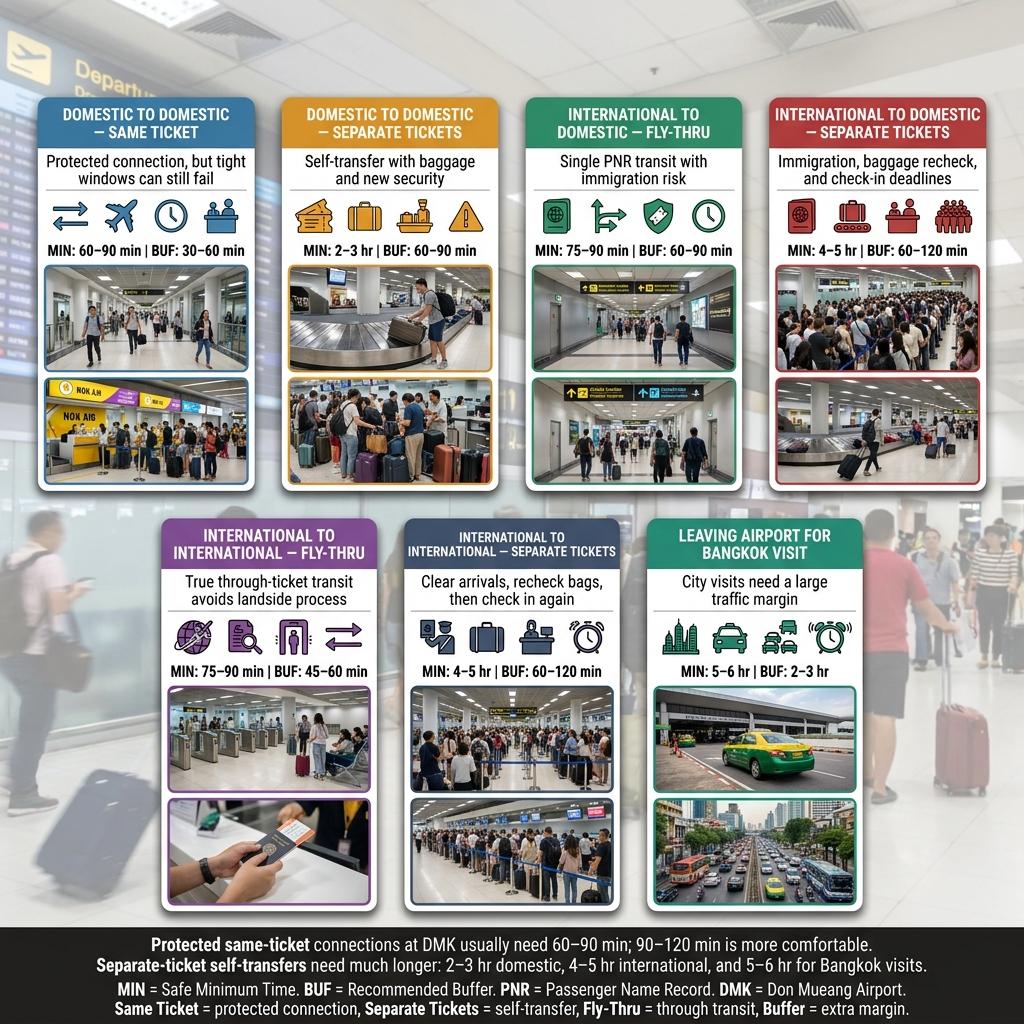
Don Mueang Airport layover connection time guide showing minimum and recommended buffer times for each transfer type at DMK Bangkok
Time at DMK is your best insurance policy. A sixty-minute window works if you're through-checked. Juggling bags and immigration on separate tickets means hours in lines. Here's a breakdown for real journeys—illustrating buffers so you can build a plan matching your connection type and risk tolerance.
| Connection Type | Safe Minimum Time | Recommended Buffer | Key Risk Factor |
|---|---|---|---|
| Domestic to Domestic (same ticket) | 60–90 minutes | 30–60 minutes | Tight change windows plus late inbound flights; Nok Air check-in closes ~45 minutes before departure, risking misconnect. |
| Domestic to Domestic (separate tickets) | 2–3 hours | 60–90 minutes | No protected connection: re-collect baggage, re-check, new security; any inbound delay easily causes a missed flight. |
| International to Domestic (same ticket / Fly-Thru) | 75–90 minutes | 60–90 minutes | Immigration plus possible terminal change; must have single PNR and stay airside for transit to work smoothly. |
| International to Domestic (separate tickets) | 4–5 hours | 60–120 minutes | Immigration queues, baggage recheck, and check-in deadlines; congestion at DMK can be severe at peak times. |
| International to International (Fly-Thru) | 75–90 minutes | 45–60 minutes | Arrival delays and required document/security checks; must be a true through/transit ticket to avoid landside process. |
| International to International (separate tickets) | 4–5 hours | 60–120 minutes | Must clear arrivals, collect/recheck bags, new check-in; immigration at DMK often swells to 2 hours in peak periods. |
| Leaving airport for Bangkok visit | 5–6 hours | 2–3 hours | Urban travel time: traffic to/from DMK varies widely (60–150+ min. each way), so city visits need a large margin. |
In summary: Short connections under 90 minutes are realistic only if booked on a single PNR or with Fly-Thru. For all self-transfer routes, double your layover buffer—especially if you want to explore Bangkok or face unpredictable city traffic.
Can you actually leave Don Mueang during a layover?
Yes, you can leave DMK during a Don Mueang Airport layover—but only if you meet four conditions: (1) Hold valid Thai entry permission (Indian passport holders are currently visa-exempt), (2) Have at least 6 hours before your next flight, (3) Arrange secure luggage storage (100–200 THB/day, or 250–500 INR, or 3–6 USD at AOT Left Luggage counters), and (4) Plan for Bangkok's heavy traffic. For speed, use the A1 shuttle to Mo Chit BTS—fast, air-conditioned, and around 30–50 THB (75–130 INR, 1–2 USD). Taxis and Grabs range from 300–400 THB (750–1,000 INR, 9–12 USD) each way. City breaks are doable, but only with long layovers and careful clock-watching.
What to do during a DMK layover
How you spend your Don Mueang Airport layover depends entirely on time. This is not a terminal built for luxury—but there are clever options for every schedule. Under three hours? Recharge airside. A few more hours buys access to quick local food or a foot massage. Long layover? You can venture out—just mind the clock and the city's notorious traffic. Whether you're on a short DMK transit or an extended Bangkok stopover, explore each scenario below for a tailored layover plan.
What to do during a 2–3 hour layover
For a short layover, stay airside. Grab a meal at the food court (30–150 THB, 75–380 INR, 1–4 USD), stretch your legs by strolling King Power duty-free, and use the free Wi-Fi for two hours. Need a refresh? Showers at the Miracle Lounge cost about 300 THB (750 INR, 9 USD). This is your moment to relax and recharge—no rushing out during your Don Mueang Airport layover.
What to do during a 4–6 hour layover
With more time, you can unwind outside of the gate. Enjoy a sit-down meal at Magic Food Point or try a local restaurant landside. Book a traditional Thai foot massage in-terminal (300–500 THB, 750–1,250 INR, 9–15 USD), or get proper rest at the Miracle Transit Hotel with day-use rooms. Looking for a change of scene? Take a taxi (within 200 THB, 500 INR, 6 USD) to IT Square mall—only a short ride away from the airport.
What to do during a 6+ hour layover
Layovers of six hours or longer open Bangkok to you. Step outside (after checking Thai entry policy) and choose an adventure: Chatuchak Weekend Market on Saturdays and Sundays (taxi 150–230 THB, 375–575 INR, 4–7 USD), a mall trip to Terminal 21 (taxi up to 500 THB, 1,250 INR, 15 USD), or temple sightseeing at Wat Pho or Wat Arun (400–600 THB each way, 1,000–1,500 INR, 12–18 USD). Always leave three hours to navigate back and clear security—Bangkok traffic is as famous as its markets. A long Don Mueang Airport layover can become a memorable mini-break if timed carefully.
Can you sleep at Don Mueang Airport?
Sleeping at DMK is basic but possible. Your options:
- Free: Upper-level benches in Terminal 1—quietest and coldest, so bring a jacket and keep bags securely close.
- Paid: Day rooms at Miracle Transit Hotel (1,500–2,500 THB; 3,750–6,250 INR; 45–75 USD) provide real beds and showers.
- Nearby: Budget hotels within walking distance run free shuttle vans for early connections. Each choice balances comfort, cost, and proximity to your gate for worry-free rest during your Don Mueang Airport layover.
Changing terminals at Don Mueang
Terminal 1 handles all international flights; Terminal 2 manages domestic departures. A five to ten-minute indoor walkway connects them on the departure level. Free shuttle buses run outside as an alternative. Check your boarding pass and the live departure screens on arrival—last-minute airline assignments do happen, and early confirmation saves you a stressful sprint during your Bangkok transit connection.
Layover vs connecting flight: what's the difference?
A Don Mueang Airport layover is the waiting period at DMK—usually less than 24 hours—while a connecting flight is the plane that carries you onward. The distinction matters: on a single ticket, you're airside and in transit. With separate tickets, you clear immigration, collect your bags, and start a new airport journey. Understanding this difference is critical for any traveler planning a Bangkok stopover or DMK transit. Always check your booking details—knowing your ticket type is the key to navigating DMK with confidence.
Smart tips for a stress-free DMK connection
Save yourself hassle with these habits:
- Prioritize single PNR bookings—these protect you from missed connections and lost bags.
- Screenshot travel essentials (boarding pass, visa, hotel)—internet at DMK can be sporadic.
- Use airline apps for real-time gate updates.
- Carry a cash buffer: 2,000–3,000 THB (5,000–7,500 INR; 60–90 USD) for snacks or baggage storage on arrival.
- Check airline and airport transfer rules right before your trip—processes can change. Bookmark this honest DMK guide for your next Don Mueang Airport layover so you always have clear, up-to-date insights on Bangkok transit procedures.
Wrapping up your DMK layover plan
The smartest Don Mueang Airport layover is a prepared one. Before heading to DMK, confirm three points: (1) Are your bags checked through or will you need to re-claim them? (2) Will you clear immigration or remain airside? (3) Do you have enough buffer time for connections or city escapes? Once these are clear, your Bangkok stopover transforms from anxiety-inducing into predictable and even enjoyable. Use this guide's timing tables and scenario plans to chart your own DMK transit route—and always re-check airline and visa policies before departure.
Frequently asked questions about DMK layovers

Phaksornkan T.
6 August 2026