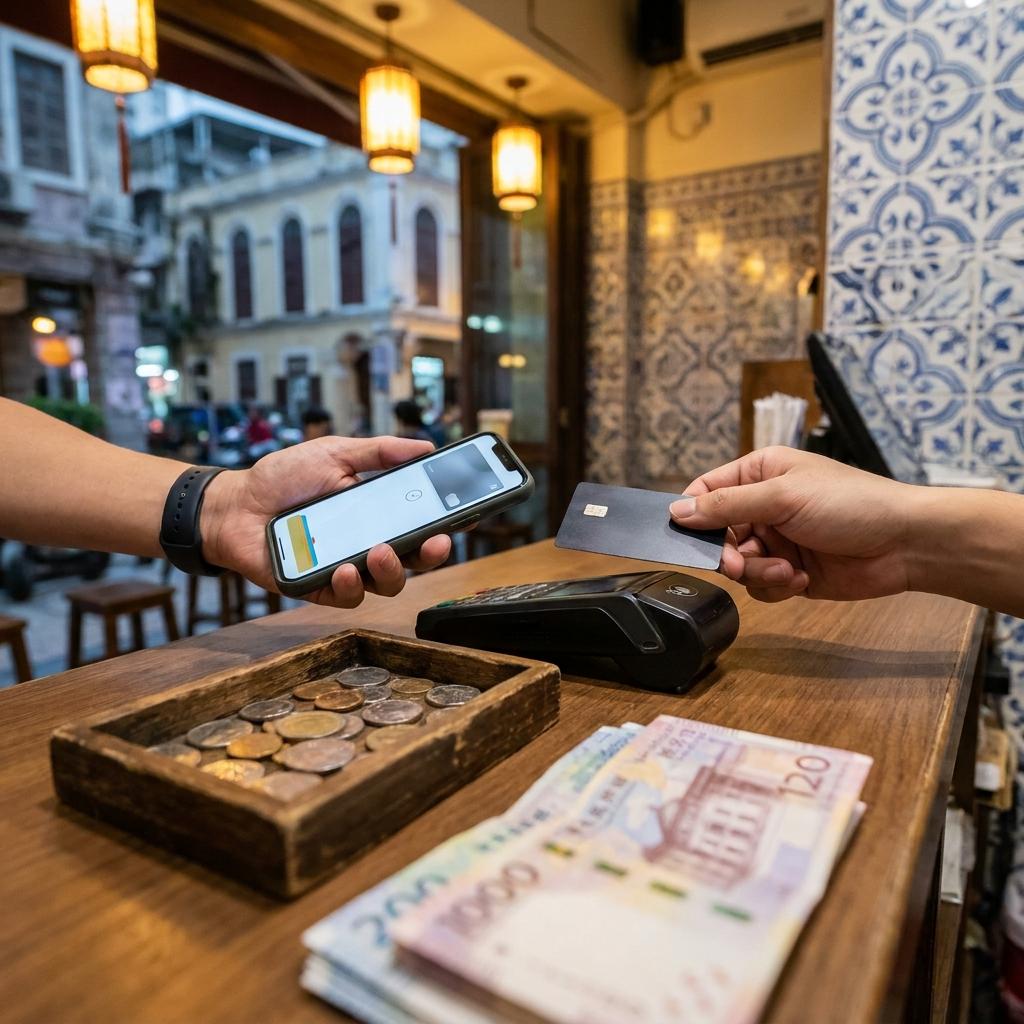
Payment Methods in Macau: Cash, Cards, QR Payments and E-Wallets

Planning a trip to Macau? You will find plenty of ways to pay, from international bank cards and mobile wallets to local QR payment services. However, not every payment method works everywhere.
The official currency is the Macanese pataca (MOP), although Hong Kong dollars (HKD) and Chinese yuan (CNY) are also used in many transactions. International cards are convenient at hotels, resorts and larger retailers, while cash remains useful for smaller purchases and some transport services.
Macau also accepts selected overseas e-wallets, including services from Malaysia, the Philippines, South Korea and other markets. The key is knowing which payment options your provider supports and where you can use them.
Here is what international travellers should know about paying in Macau, including currency exchange, public transport, ATMs and digital payments.
What payment methods can tourists use in Macau?
Travellers can generally use a combination of cash, international bank cards and supported mobile payment services.
| Payment method | Where it is useful | Tourist access | Important things to know |
|---|---|---|---|
| Macanese pataca (MOP) | Small shops, markets, transport and everyday purchases | Widely accessible | Official currency; carry smaller denominations |
| Hong Kong dollar (HKD) | Many shops, hotels and tourist businesses | Widely accepted | Change may be returned in MOP |
| Chinese yuan (CNY) | Selected shops, transport and businesses | Accepted in some places | Check the exchange rate used by the merchant |
| Visa and Mastercard | Hotels, resorts, shopping centres and larger restaurants | Generally accessible | Acceptance varies by merchant and card issuer |
| UnionPay | Retail, hotels and other participating merchants | Widely useful, particularly for eligible cards | Check your card's overseas usage settings |
| Overseas e-wallets | Participating shops and merchants | Depends on the provider and merchant | Selected services such as GCash and Touch ’n Go eWallet are listed by the tourism authority |
| Local e-wallets | Local merchants and some transport services | Depends on registration and account eligibility | Some services are primarily designed for local users |
| Apple Pay | Participating contactless terminals | Depends on the card issuer and merchant | Your card must be eligible for Apple Pay |
| Google Wallet | Participating contactless terminals | Depends on the card issuer and merchant | Check whether your card is supported for contactless payments |
The Macao Government Tourism Office lists international card networks and several domestic and overseas digital payment services as accepted in the territory. However, this does not guarantee that every merchant accepts every payment option.
For the most reliable coverage, bring an international bank card and some MOP cash. You can also use a supported mobile wallet where available.
What is Macau currency?
The official currency of Macau is the Macanese pataca (MOP), which is divided into 100 avos. Its currency symbol is MOP or MOP$.
Common banknotes include:
- MOP 10
- MOP 20
- MOP 50
- MOP 100
- MOP 500
- MOP 1,000
Coins are available in denominations of 10, 20 and 50 avos, as well as MOP 1, 2, 5 and 10.
The pataca is linked to the Hong Kong dollar. The official reference rate published by the Macao Government Tourism Office is MOP 103.20 to HKD 100. However, some businesses may accept HKD and CNY at a 1:1 transaction rate against the pataca.
This means that the amount you receive in change can differ depending on the currency you use and the merchant's exchange arrangement.
Can you use Chinese yuan in Macau?
Chinese yuan (CNY or RMB) is accepted by some businesses in Macau, particularly those serving visitors from Mainland China.
However, acceptance and exchange rates vary by merchant. You may receive change in patacas, so check the amount before completing your transaction.
If you are travelling from Mainland China, check whether your usual payment app or bank card can be used at your destination.
Can you use Hong Kong dollars in Macau?
Yes. Hong Kong dollars are widely accepted in Macau, particularly at hotels, casinos, shopping areas and tourist-oriented businesses.
However, HKD is not Macau's official currency. If you pay in Hong Kong dollars, a merchant may return your change in patacas. The exchange rate used can also vary.
For everyday purchases, it is useful to carry some MOP cash rather than relying entirely on HKD.
Are credit and debit cards accepted in Macau?
Yes. International credit and debit cards are accepted at many businesses in Macau, including hotels, integrated resorts, shopping centres and established restaurants.
The Macao Government Tourism Office lists Visa, Mastercard, American Express, JCB and UnionPay among the widely accepted card networks.
However, card acceptance is not universal. Smaller shops, street vendors and some local businesses may prefer cash or QR payments.
Can you use American Express and UnionPay?
Both American Express and UnionPay are listed by the Macao Government Tourism Office among the accepted card networks.
However, acceptance depends on the merchant and its payment terminal. UnionPay can be particularly useful for travellers from Mainland China and markets where UnionPay cards are common.
If you rely on American Express or another less widely used card network, bring a Visa or Mastercard as a backup.
Can you use Visa and Mastercard in Macau?
Generally, yes. Visa and Mastercard are useful for hotel payments, shopping, restaurants and other larger purchases.
Before travelling, check that your card is enabled for overseas transactions. Make sure you know your PIN, as some terminals may require chip-and-PIN rather than contactless payment.
For hotel stays, a credit card can also be useful for deposits and incidental charges. Check the hotel's payment and deposit policies before arrival, as debit cards may be treated differently.
Should you pay in MOP or your home currency?
When a card terminal offers to charge you in your home currency instead of the transaction currency, check the conversion rate before accepting.
This service is known as dynamic currency conversion (DCC). It allows the merchant or payment provider to convert the payment into your home currency, but the exchange rate may be less favourable than your card issuer's rate.
Where possible, choose the transaction currency offered by the merchant, such as MOP or HKD, and let your card issuer handle the conversion.
Your bank may still charge a foreign transaction fee, so check its overseas payment policy before travelling.
Can you use QR payments and international e-wallets in Macau?
Yes. Macau QR payments supports a range of local and overseas mobile payment services. This is particularly useful for travellers who prefer paying through their usual banking or e-wallet app.
The Macao Government Tourism Office lists several overseas services accepted by participating merchants, including:
| Country or market | Payment services listed |
|---|---|
| Mainland China and Hong Kong | Alipay and WeChat Pay |
| Malaysia | Touch ’n Go eWallet and MyPB by Public Bank |
| Philippines | GCash |
| South Korea | KakaoPay, Toss Pay and NAVER Pay |
| Thailand | TrueMoney |
| Singapore | OCBC and Changi Pay |
| Mongolia | Hipay |
| Italy | Tinaba |
This list does not mean that every merchant accepts all the services shown. Payment availability depends on merchant participation, the wallet's cross-border arrangements and your account eligibility.
Before travelling, check with your payment provider to confirm that overseas payments are enabled, your account is eligible and any foreign exchange or transaction fees are clear.
Can you use Alipay and WeChat Pay?
Yes. Alipay and WeChat Pay are commonly used in Macau, particularly by visitors and businesses serving travellers from Mainland China and Hong Kong.
The Macao Government Tourism Office lists both services among the digital payment options accepted by local merchants.
If you are using an international version of either app, check its cross-border payment settings and supported merchant arrangements before travelling. The availability of a service can differ between account regions.
Can you use GCash in Macau?
GCash is also listed by the Macao Government Tourism Office as an accepted overseas payment service.
Filipino travellers should check the app's overseas payment eligibility and look for participating merchants displaying the relevant payment option. Do not assume that every QR code in Macau can be scanned using GCash.
Can you use Touch ’n Go eWallet in Macau?
The Macao Government Tourism Office lists Malaysia's Touch ’n Go eWallet among the overseas payment services accepted by participating merchants.
However, this does not guarantee acceptance at every shop or restaurant. Look for the relevant payment logo or ask the merchant before paying.
Check the Touch ’n Go app and its official support information for current overseas payment availability, exchange rates and applicable fees.
Can you use local e-wallets such as MPay?
Macau has local payment services such as MPay, which are used for retail purchases and other everyday transactions.
However, registration and account requirements can vary. Some services may require local identification, a Macau mobile number or a compatible financial account.
Short-term visitors should check the latest registration requirements directly with the provider rather than assuming that every local wallet is available to overseas users.
Does Apple Pay and Google Wallet work in Macau?
Apple Pay and Google Wallet can be used for contactless payments where the card, device and merchant terminal are compatible.
However, the availability of a mobile wallet in Macau does not automatically mean that every overseas card can be added or used. Your card issuer must support the service, and the merchant must accept contactless payments.
Google Wallet in Macau
Google Wallet supports contactless payments with eligible cards and devices, but card availability depends on the issuing bank.
Google's supported payment information for Macau currently lists eligible cards from Banco Nacional Ultramarino (BNU). This does not establish that every overseas card will work, so check your own bank's eligibility and regional support before travelling.
Your Android device must also support NFC for contactless payments.
For both services, carry your physical card and some cash as backup. Not every merchant accepts mobile payments.
Apple Pay in Macau
Apple Pay is officially available in Macau. Visitors can use eligible cards from participating issuers at merchants displaying the contactless payment symbol.
If you already use Apple Pay at home, check that your bank supports overseas transactions through the service. You should also add and verify your card before departure.
Macau Public Transportation Payment
Transport is one area where visitors should prepare their payment method in advance. Payment options differ between buses, taxis and the Light Rapid Transit (LRT).
Paying for Macau buses
Macau's public buses accept cash and selected electronic payment methods.
The standard bus fare is MOP 6 when paying cash. The Macao Government Tourism Office advises passengers to prepare the exact amount because buses do not give change.
Visitors can also use Macau Pass, an electronic stored-value card accepted on public transport. The card can also be used at some convenience stores, bakeries and vending machines.
The Transport Bureau also lists approved QR-code payment options for bus fares. These include selected local wallets and Alipay and WeChat Pay from Mainland China and Hong Kong. Eligibility and fare discounts may differ depending on the payment method.
Do not assume that an ordinary Visa or Mastercard contactless card will work directly on the bus. Check the current approved payment list before travelling.
For routes and current payment arrangements, visit the Macao Transport Bureau.
Paying for the Macau Light Rapid Transit (LRT)
The LRT is another way to travel around Macau, particularly in Taipa and Cotai.
Check the LRT operator's official website for current ticketing and payment options before travelling. Do not assume that the payment methods accepted on public buses are automatically accepted on the LRT.
Visit Macau Light Rapid Transit for fare and ticket information.
Paying for taxis
Carry MOP cash when taking a taxi in Macau. Do not assume that every taxi accepts international bank cards or overseas e-wallets.
The Macao Government Tourism Office publishes the official taxi fare structure, including the starting fare and additional charges. Check the meter and confirm the payment method before your journey if you intend to use anything other than cash.
You can also use the official radio taxi service or its app to arrange a ride. Check the service's current payment options when booking.
Withdrawing cash from ATMs in Macau
ATMs are available throughout Macau, including at banks, shopping areas and major hotels. Many machines support international card networks, making them a convenient way to obtain patacas.
Before travelling, check that your bank allows overseas cash withdrawals and confirm your daily withdrawal limit.
You may encounter several types of charges:
- Local ATM fee: The ATM operator may charge for processing your withdrawal.
- Overseas withdrawal fee: Your bank may charge a fee for using an ATM abroad.
- Currency conversion fee: Your card issuer may apply a foreign exchange markup.
The exact charges depend on the ATM operator and your bank. Review the fees shown on the ATM screen before confirming your withdrawal.
If the ATM offers to convert the withdrawal into your home currency, compare the rate carefully. Choosing MOP generally allows your card issuer to handle the conversion instead of accepting the ATM's DCC rate.
For security, use ATMs inside established bank branches or reputable commercial buildings. Shield your PIN and keep your card and cash secure after withdrawing.
Where to exchange money in Macau
You can exchange foreign currency at banks, authorised money changers, airports, ferry terminals and many major hotels.
The Macao Government Tourism Office confirms that currency exchange services are available at the airport, docks and hotels, with banks and money changers found throughout the territory.
For a better rate, compare several providers before exchanging a larger amount. Check the displayed buying and selling rates and ask whether any commission or service charge applies.
Airport and hotel counters can be convenient when you first arrive, but their rates may not be the most competitive.
A practical approach is to exchange a small amount for your first transport journey and immediate expenses, then compare rates at authorised exchange providers in town.
Which payment method should you use in different situations?
The best payment method depends on what you are paying for and where you are.
| Travel situation | Recommended payment method | Backup |
|---|---|---|
| Hotels and integrated resorts | International credit card | Second card |
| Shopping centres and larger retailers | Visa, Mastercard, UnionPay or supported mobile wallet | Cash |
| Local restaurants and cafés | Card, supported QR payment or cash | MOP cash |
| Street food and small shops | MOP cash or a supported QR wallet | Small banknotes |
| Public buses | Exact MOP cash, Macau Pass or approved QR payment | Another approved bus payment method |
| Taxis | MOP cash | Confirm another option with the driver |
| Museums and attractions | Online booking or payment methods accepted at the venue | Physical card or cash |
| ATMs | International debit card | Second card or cash reserve |
For casino gaming, check the venue's own payment and cash-access arrangements. Do not assume that a payment card accepted for hotel, restaurant or retail spending can also be used to obtain gaming funds.
Tips for paying safely and avoiding extra fees in Macau
A little preparation can help you avoid unnecessary charges and payment problems during your trip.
- Carry some patacas. Cash is useful for public buses, small shops and places that do not accept your preferred payment method.
- Choose the transaction currency carefully. Check the exchange rate before accepting a conversion into your home currency at a card terminal or ATM.
- Check overseas fees before departure. Your bank or e-wallet provider may charge foreign transaction, conversion or withdrawal fees.
- Bring a backup card. Keep a second card separately in case your main card is lost, blocked or declined.
- Check QR compatibility. Confirm that your e-wallet supports payments in Macau and look for the relevant payment logo at the merchant.
- Use official payment channels. Scan QR codes displayed at the merchant's payment counter rather than codes sent by strangers or displayed in suspicious locations.
- Keep your phone charged. Mobile wallets and QR payments depend on your device and, in some cases, internet connectivity.
- Use secure ATMs and exchange providers. Choose established banks and authorised money changers.
- Keep smaller banknotes. These are particularly useful for bus fares and small purchases.
Plan your Macau trip with confidence
Paying in Macau is relatively straightforward once you understand the different options. International cards are useful for hotels, shopping and larger purchases, while pataca cash remains important for public transport and smaller transactions.
You may also be able to use your usual mobile wallet. Macau accepts selected overseas services, including Touch ’n Go eWallet and GCash, alongside local and regional payment options. Check your provider's eligibility requirements and fees before departure.
With a backup card, some local cash and a compatible mobile payment option, you can manage most everyday transactions with greater confidence.
Ready to plan the rest of your trip? Explore flights, accommodation and activities with AirAsia MOVE to organise your Macau holiday.